An American Jesus, (2024)
An American Jesus, 2024. 16mm short film, 00:11:04. Written and directed by Quinn Matthews. Starring Eli Brown and Dylan Arnold
An American Jesus is a 16mm short film that interrogates the Jesus-like rhetoric of Donald Trump.
Ahead of the 2024 presidential election, Trump’s campaign increasingly spoke in the language of martyrdom. His messaging described a persecuted man who would endure torment willingly on behalf of his supporters. In the weeks before his New York trial, the headline across his campaign website read, “They’re not after me, they’re after you … I’m just standing in the way!”
As early as 2016 he had told crowds, “Nevertheless, I take all of these slings and arrows gladly for you.” A campaign video titled God Made Trump, voiced by an AI imitation of the broadcaster Paul Harvey, played before he took the stage multiple times in Iowa, describing “a shepherd to mankind who will never leave nor forsake them.” Within QAnon and adjacent conspiracy communities, support for his re-election did not resemble political allegiance. It resembled faith -Trump understood as a messiah figure siding with the Good against the Evil. His persecution was itself the proof of his chosenness.
Writing about this condition presents a particular problem. Roderick Hart describes the challenge of “explaining the multidimensionality of a unidimensional man,” observing that Trump’s rhetoric is so exaggerated that “he begs to be caricatured.” Any political dialogue I might write for a film would read as parody, and parody would allow the audience the comfort of distance. So I did not write dialogue. I became interested in reauthoring language already participating in political reality.
The screenplay is composed almost entirely of found language gathered from Trump’s speeches, campaign videos, interviews, and fundraising emails, alongside rhetoric circulating through QAnon communities. QAnon is often dismissed as a fringe internet community. The polling suggests otherwise. By PRRI’s measure, nearly one in five Americans qualified as QAnon believers by 2024 -up from 14% in 2021 -agreeing, among other core statements, that “there is a storm coming soon that will sweep away the elites in power and restore the rightful leaders.” That storm returns in the film’s sermons nearly verbatim. The film’s source material is not marginal speech. It is one of the largest bodies of shared political belief in the United States.
Throughout the script, Trump’s name is omitted and replaced with the pronoun He. The substitution shifts attention away from an individual and toward the language itself. Detached from its origin, familiar campaign rhetoric begins to resemble prophecy. The film does not ask how a politician becomes Christ. It asks how political rhetoric becomes legible as religious language.
In the film this language belongs to David, an online vlogger and the father of Alex’s friend Bryce. His recordings reach Alex, a young man at the far edge of the economy -his work canceled, his power shut off, his own father awaiting sentencing. The recordings arrive dated, like scripture:
Nearly every sentence is Trump’s, describing himself. The film’s only intervention is the pronoun. I wrote Alex’s radicalization as accumulation rather than argument. He watches the videos in the dark of a house with the power shut off, and their promises repeat until they harden into certainty. His belief does not come from stupidity. It comes from abandonment, and from the promise that someone is finally fighting for him.
As Alex begins planting JESUS 2024 signs and flags around town, David’s videos echo God Made Trump, the AI campaign video that went viral and was adopted by Trump into his official campaign tour:
By the final act, the language has radicalized Alex, who now warns of the coming Storm himself.
During location scouting I became interested in Blythe, California, a small town on the Colorado River between California and Arizona where naturally occurring Christian imagery already occupied the landscape. Church marquees, handmade crosses, scripture banners, and roadside declarations of faith existed alongside campaign signs, interstate infrastructure, and vacant desert. Little intervention was required. The landscape had already begun producing the visual language the film sought to examine. The film’s additions, JESUS 2024 flags and yard signs set in Trump’s campaign typography, entered alongside sincere declarations and were largely indistinguishable from them. The film was shot in early 2024, and by the final months of the race, imagery the film had interpreted was present on its own.
A men’s prison outside town became a point of departure for the writing. Large highway signs warn drivers not to pick up hitchhikers because of the correctional facility nearby. The film ends inside that warning. Alex, his truck loaded with flags, stops for a hitchhiker he is certain is Jesus meeting him on the road -a figure who more closely resembles a transient Donald Trump.
Alex extends trust before certainty is possible. The warning arrives only after belief has taken hold. The hitchhiker is not there to be guilty or innocent. He is there to be believed and misrecognized.
_
Shot on 16mm, the film is periodically interrupted by David’s webcam vlogs. The film image observes. The vlog image recruits.
The JESUS 2024 flag sewn as a prop for this film did not remain one. Reauthored behind bullet-resistant glass, it became the sculpture White Light. The film and the sculpture share a condition: both were produced inside a state of anticipation, before the outcome they present.
The rhetoric required no exaggeration.
Only removal.
![]()
Poster Image: Hector Clark
Ahead of the 2024 presidential election, Trump’s campaign increasingly spoke in the language of martyrdom. His messaging described a persecuted man who would endure torment willingly on behalf of his supporters. In the weeks before his New York trial, the headline across his campaign website read, “They’re not after me, they’re after you … I’m just standing in the way!”
As early as 2016 he had told crowds, “Nevertheless, I take all of these slings and arrows gladly for you.” A campaign video titled God Made Trump, voiced by an AI imitation of the broadcaster Paul Harvey, played before he took the stage multiple times in Iowa, describing “a shepherd to mankind who will never leave nor forsake them.” Within QAnon and adjacent conspiracy communities, support for his re-election did not resemble political allegiance. It resembled faith -Trump understood as a messiah figure siding with the Good against the Evil. His persecution was itself the proof of his chosenness.
Writing about this condition presents a particular problem. Roderick Hart describes the challenge of “explaining the multidimensionality of a unidimensional man,” observing that Trump’s rhetoric is so exaggerated that “he begs to be caricatured.” Any political dialogue I might write for a film would read as parody, and parody would allow the audience the comfort of distance. So I did not write dialogue. I became interested in reauthoring language already participating in political reality.
The screenplay is composed almost entirely of found language gathered from Trump’s speeches, campaign videos, interviews, and fundraising emails, alongside rhetoric circulating through QAnon communities. QAnon is often dismissed as a fringe internet community. The polling suggests otherwise. By PRRI’s measure, nearly one in five Americans qualified as QAnon believers by 2024 -up from 14% in 2021 -agreeing, among other core statements, that “there is a storm coming soon that will sweep away the elites in power and restore the rightful leaders.” That storm returns in the film’s sermons nearly verbatim. The film’s source material is not marginal speech. It is one of the largest bodies of shared political belief in the United States.
Throughout the script, Trump’s name is omitted and replaced with the pronoun He. The substitution shifts attention away from an individual and toward the language itself. Detached from its origin, familiar campaign rhetoric begins to resemble prophecy. The film does not ask how a politician becomes Christ. It asks how political rhetoric becomes legible as religious language.
In the film this language belongs to David, an online vlogger and the father of Alex’s friend Bryce. His recordings reach Alex, a young man at the far edge of the economy -his work canceled, his power shut off, his own father awaiting sentencing. The recordings arrive dated, like scripture:
DAVID (V.O.)
No matter what our sick and deranged establishment throws at Him, no matter what they do to Him, He will endure their torment and oppression, and He will do it willingly. Now He has put everything on the line to fight for you. He’s risked it all to defend the working class. He is the only one that can save this. They are not after Him, they are after Us, and He is standing in the way!
No matter what our sick and deranged establishment throws at Him, no matter what they do to Him, He will endure their torment and oppression, and He will do it willingly. Now He has put everything on the line to fight for you. He’s risked it all to defend the working class. He is the only one that can save this. They are not after Him, they are after Us, and He is standing in the way!
Nearly every sentence is Trump’s, describing himself. The film’s only intervention is the pronoun. I wrote Alex’s radicalization as accumulation rather than argument. He watches the videos in the dark of a house with the power shut off, and their promises repeat until they harden into certainty. His belief does not come from stupidity. It comes from abandonment, and from the promise that someone is finally fighting for him.
As Alex begins planting JESUS 2024 signs and flags around town, David’s videos echo God Made Trump, the AI campaign video that went viral and was adopted by Trump into his official campaign tour:
DAVID (V.O.)
God looked down on his planned paradise and said I need a caretaker, so God gave us Him. God said I need somebody willing to get up before dawn, work all day, and stay past midnight, so God made Him. I need somebody with arms strong enough to wrestle the deep state and yet gentle, so God gave us Him. A man who cares for the flock, a shepherd to mankind who will never leave nor forsake them. So God made Him.
God looked down on his planned paradise and said I need a caretaker, so God gave us Him. God said I need somebody willing to get up before dawn, work all day, and stay past midnight, so God made Him. I need somebody with arms strong enough to wrestle the deep state and yet gentle, so God gave us Him. A man who cares for the flock, a shepherd to mankind who will never leave nor forsake them. So God made Him.
By the final act, the language has radicalized Alex, who now warns of the coming Storm himself.
ALEX
I’m finally standing up and saying no. And we fight. We fight like hell. And if you don’t fight like hell, you’re not going to have a country anymore.
I’m finally standing up and saying no. And we fight. We fight like hell. And if you don’t fight like hell, you’re not going to have a country anymore.
_
During location scouting I became interested in Blythe, California, a small town on the Colorado River between California and Arizona where naturally occurring Christian imagery already occupied the landscape. Church marquees, handmade crosses, scripture banners, and roadside declarations of faith existed alongside campaign signs, interstate infrastructure, and vacant desert. Little intervention was required. The landscape had already begun producing the visual language the film sought to examine. The film’s additions, JESUS 2024 flags and yard signs set in Trump’s campaign typography, entered alongside sincere declarations and were largely indistinguishable from them. The film was shot in early 2024, and by the final months of the race, imagery the film had interpreted was present on its own.
A men’s prison outside town became a point of departure for the writing. Large highway signs warn drivers not to pick up hitchhikers because of the correctional facility nearby. The film ends inside that warning. Alex, his truck loaded with flags, stops for a hitchhiker he is certain is Jesus meeting him on the road -a figure who more closely resembles a transient Donald Trump.
Alex extends trust before certainty is possible. The warning arrives only after belief has taken hold. The hitchhiker is not there to be guilty or innocent. He is there to be believed and misrecognized.
_
Shot on 16mm, the film is periodically interrupted by David’s webcam vlogs. The film image observes. The vlog image recruits.
The JESUS 2024 flag sewn as a prop for this film did not remain one. Reauthored behind bullet-resistant glass, it became the sculpture White Light. The film and the sculpture share a condition: both were produced inside a state of anticipation, before the outcome they present.
The rhetoric required no exaggeration.
Only removal.
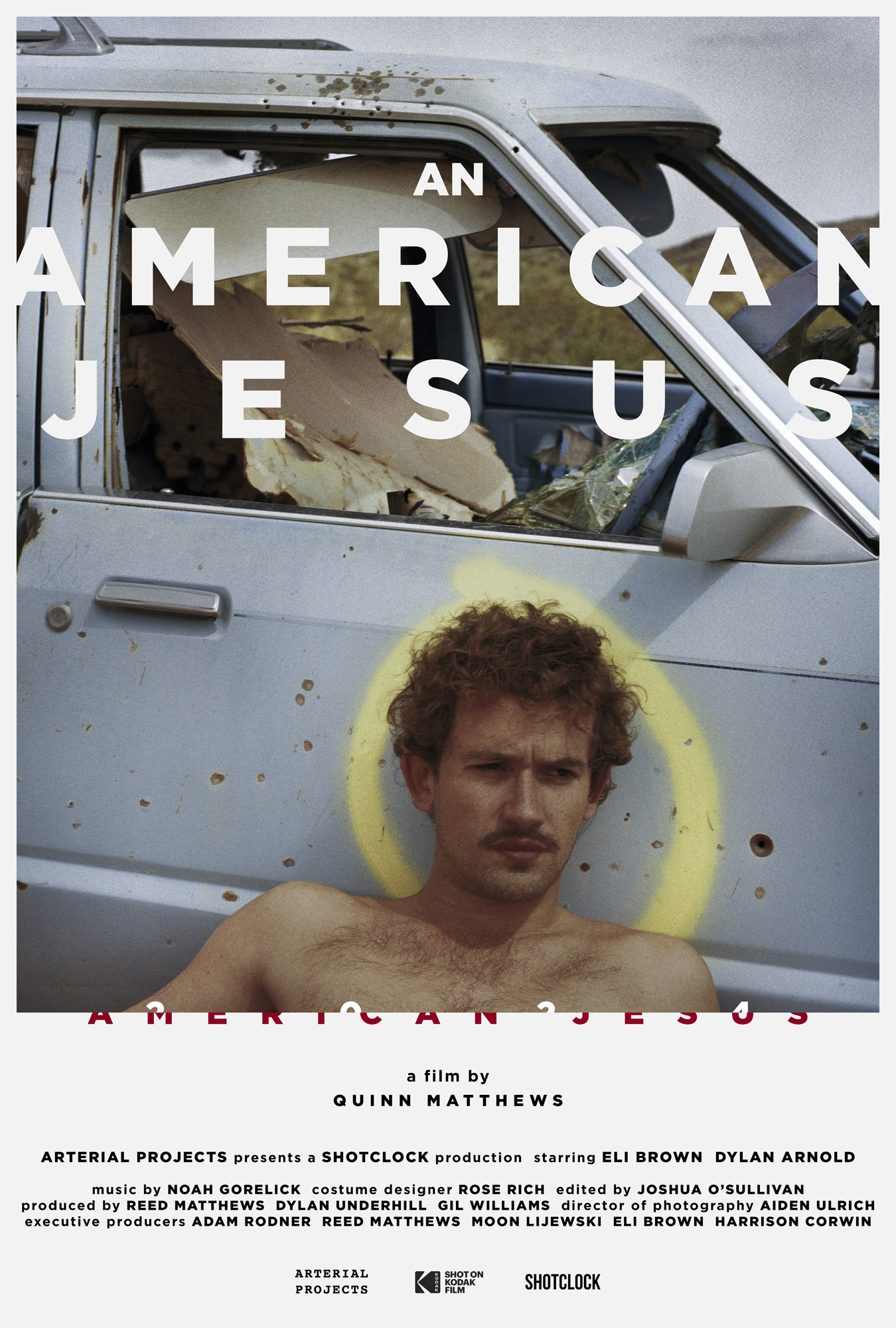
Poster Image: Hector Clark