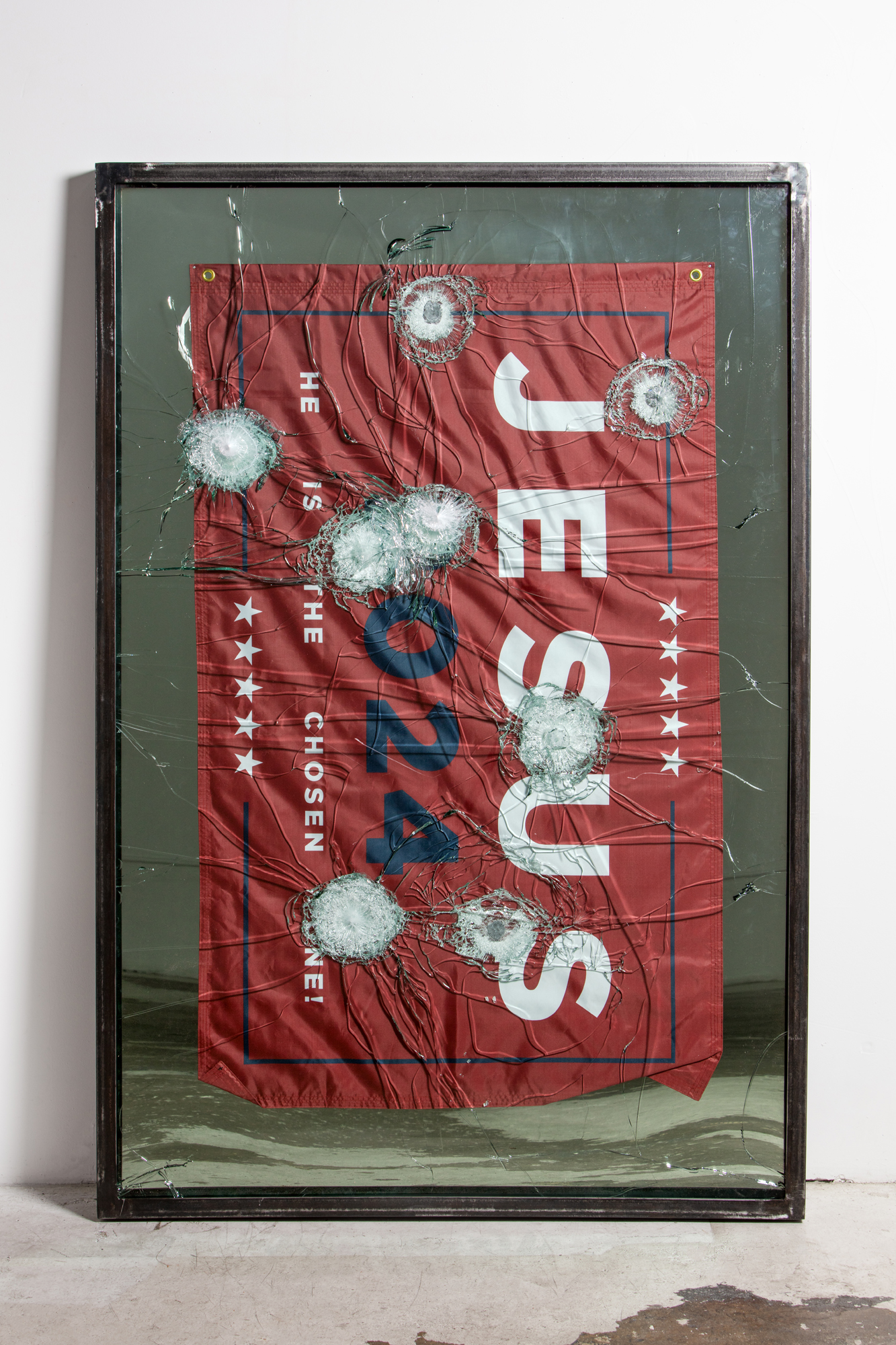
White Light, (2024)
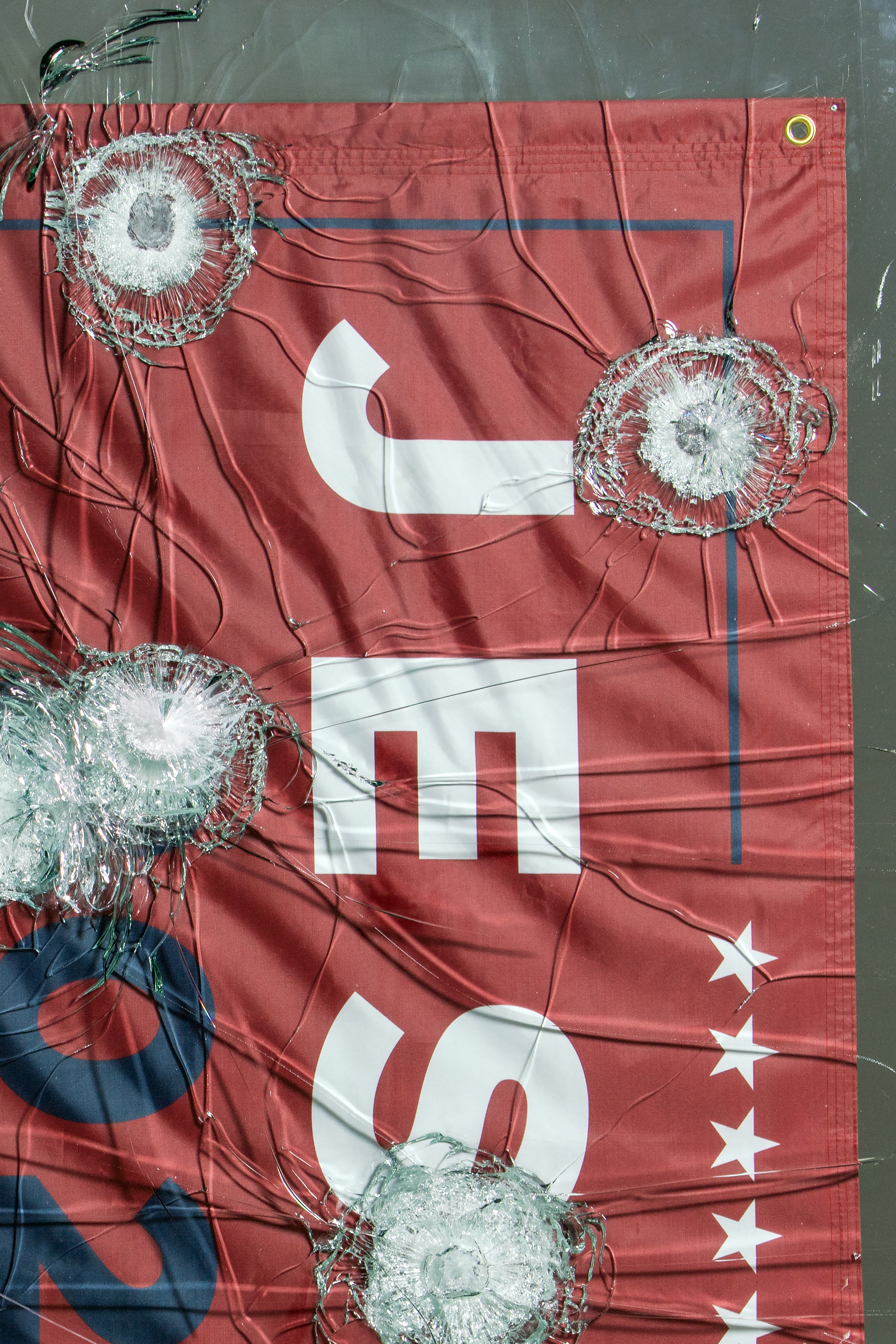
White Light, 2024. Nylon flag, Level 7 bullet-resistant glass, .223 ammunition, steel, 188 × 127 × 12.7 cm | 74 × 50 × 5 inches
Political authority has long depended upon images. None more so than a campaign for the US presidency, which largely centers on the idea of the public image.
Trump’s political identity has been produced through spectacle. He has fabricated a false image and performance associated with campaigning in the theater of new American politics -where campaign rallies, social media, television, memes, AI-generated imagery, and conspiracy communities collectively manufacture a public figure whose authority often exists independently of factual evidence.
Looking to the rhetoric and ideologies pertaining to Trump present on social media and alt-platforms, we can trace that from the populist extremes of Trumpism, which originated during his 2016 campaign, came the emergence of QAnon in 2017, a radicalized group that formed on 4chan. Early beliefs shared the ideology that Trump was fighting against a secret cannibalistic cabal within American and world political systems. Later, QAnon was responsible for a significant amount of disinformation and the support of anti-lockdown and anti-vaccine protests. However, the most striking involvement from QAnon with intention to influence political unrest was the January 6, 2021, insurrection and attack on the US Capitol building.
Leading to that moment, through his first presidency Trump acted impulsively on social media, understanding the digital landscape as somewhere to influence followers and share content directly and regardless of accuracy or politeness. Following the January 6, 2021, attack on the US Capitol, Donald Trump and his accounts were then indefinitely banned from Twitter, Facebook, Instagram, Snapchat, YouTube, and Twitch. The platforms all cited the risk of further incitement of violence. On January 7, 2021, Mark Zuckerberg stated, “the risks of allowing the President to continue to use our service during this period are simply too great.” However, Twitter, renamed X after Elon Musk’s acquisition, reinstated his account in 2022, and Facebook, Instagram, and YouTube followed in 2023.
During his absence from popular social media, roughly 2021-2023, the movements of Trumpism and QAnon shifted to alt-platforms and Trump’s personal social media platform, Truth Social, launched in 2022 as a response to his removal from mainstream social media. Here Trump could talk unregulated to followers without any oversight or accountability for reality. He carefully built affective publics, warning of the potential of tomorrow and that he was there to fight for them. Once the momentum started, these groups and the extremist content that was widely shared polarized and radicalized a number of users.
After time in the isolation and echo-chambers of alternative social media, these ideas resurfaced on mainstream media when Trump took center stage again ahead of his 2024 presidential campaign. Except now, Trumpism and a significant amount of the support for his re-election campaign in 2024 did not result from usual political standards but rather from a theological interpretation that saw Trump as a liberator and martyr siding with the Good against the Evil.
In these online social groups which hinge on the potential of tomorrow’s threats, Trump is often seen by conspiracy theorists with religious backgrounds as a sort of messiah to free the oppressed. Trump, through rhetoric, imagery, and posturing, has cemented himself as a central figure in conspiracy religious imagery where he is portrayed and perceived as Jesus-like.
Users on these platforms are influenced by what they interpret as the selfless intention of Trump, for he did not need to become president but chose the difficult, unrewarding path because the American people needed him. In turn, his 2024 campaign was read through the evangelical teaching that Jesus had nothing to gain from coming to Earth, yet made the ultimate sacrifice to save humanity. In a thorough study of Truth Social, Bailey Galicia finds that “Truth Social users see the 2024 election as the resurrection - the great return of their unfairly prosecuted Chosen One.” This religious imagery was widely spread across various social media sites. Similarly, a visual semiotics analysis of the same imagery present on the platform Telegram looked at the role of temporary meme images and concluded that “QAnon’s religious imagery repeatedly portrays themes centred on Trumpism and US Christian nationalism. The US flag is often used as a symbol to convey national identity, while the US President Trump is repeatedly depicted as a messiah figure anointed by Jesus.” Images placing Trump alongside Christ, surrounded by divine light, protected by angels, or chosen by God circulate widely, and they circulate as sincere belief rather than satire. Political participation becomes inseparable from religious imagery, and events are read through prophecy, apocalypse, and redemption.
These ideas and religious promises regarding apocalyptic comings gain support after people experience a severe destabilization and when existing social and economic institutions fail to provide recourse. Set against the uncertainty surrounding the pandemic, rising US nationalism, and the presence of misinformation, this led to a divisive belief across political parties that either opponent’s success would be seen as an end-time in American politics. Some Democrats believed that if Trump won it would be the end of decorum in the Capitol and some Republicans believed that if Biden won it would be the end of America as a dominant power in the world.
_
In White Light I interrogate Trumpism’s weaponizing of Christian extremism in imagery and rhetoric, and how political imagery acquires theological authority. I exaggerate visual languages already present within campaign imagery to reconstruct the conditions under which that image is understood.
I do not treat political violence as an isolated event, but as part of a history in which images of violence are continually circulated and interpreted. Following the assassination attempt, photographs of Trump raising his fist beneath the American flag were immediately transformed into campaign imagery, religious illustrations, AI-generated images, and conspiracy narratives. Within hours, the event had already begun to exceed its own documentation.
The contemporary presidency increasingly operates through the same visual economy as social media. Authority is no longer produced solely through institutions but through the continual reproduction of images across social networks.
A political image may document an event. A spectacle no longer depends upon the event itself. The authority is produced through repetition and circulation. Guy Debord describes the spectacle not as a collection of images but as a social relationship mediated through images. White Light approaches Trump’s public identity through this condition. The work is less concerned with the man than with the image that has come to replace him.
Rather than inventing a new mythology, I exaggerate one that had already begun to circulate until it becomes plainly visible. Images become politically effective not when they accurately describe reality, but when they become sufficiently legible to circulate as truth.
The title White Light refers to the mythology that emerged around a higher power protecting Trump following the assassination attempt, and to structures of whiteness that continue to shape American political identity.
I designed a nylon flag in the format of Trump’s 2024 campaign materials -JESUS 2024 where the flag would read TRUMP 2024, and HE IS THE CHOSEN ONE where it would read MAKE AMERICA GREAT AGAIN. The phrase is Trump’s own, said of himself in 2019. In the third person it reads as scripture. Neither substitution breaks the flag.
I suspended the flag behind Level 7 bullet-resistant glass and shot it eight times with .223 Remington rounds from an AR-15, matching the caliber associated with the attempted assassination of Trump during the 2024 campaign in Butler, Pennsylvania. The glass is rated to stop five rounds. On impact the ammunition melted into the ballistic glass and fractured the surface of what became the inside of the image’s frame. As a result, political violence becomes embedded within the object rather than represented by it.
The polished mirrored surface behind the flag implicates the viewer. Audience members encounter themselves reflected alongside the flag -their gaze becomes part of the work when the reflections are observed by others. Authority of political spectacle depends not only upon its production but upon its continual circulation through spectatorship.
Campaign materials, focused primarily on presidential image awareness, hold their value not in permanence but in circulation. The campaign flag is inherently temporary. It is designed for a single election cycle before becoming politically obsolete.
As such, campaign materials exist almost entirely in anticipation. They are images directed toward futures that have not yet occurred. Their authority depends upon belief rather than history. Whereas works interpreting an already established national symbol such as Flag (1954/55) by Jasper Johns, African-American Flag (1990) by David Hammons, Trinket (2008/15) by Pope.L, Gibbet (1993/94) by Cady Noland, Moral Disengagement (2014/17) by June Clark, and others historically approached the American flag looking to expose contradictions embedded in the recognizable iconography, White Light intervenes before political imagery has stabilized into history. The campaign flag differs from the national flag in that it does not represent a country. It represents a possible future.
Monuments traditionally emerge after historical events, archiving collective memory through permanence. White Light reverses this chronology. I made the work during the 2024 presidential campaign, before the outcome of the election.
The sculpture weighs more than fourteen hundred pounds. The flag it holds was designed to last one election cycle. Rather than commemorating the end of a political era, the work occupies the uncertainty preceding it.
White Light doesn’t memorialize an event or individual -it functions as a monument to a state of anticipation.